Current Activities | Recent Activities | Past Activities
Pilot Watershed Partnerships: H.J. Andrews Experimental Forest
Using Electrical Resistivity Surveying to Determine Hyporheic Zone Sediment Structure
Location - H.J. Andrews Experimental Forest, OR
Watershed partners - Oregon State University
Date - August 2006
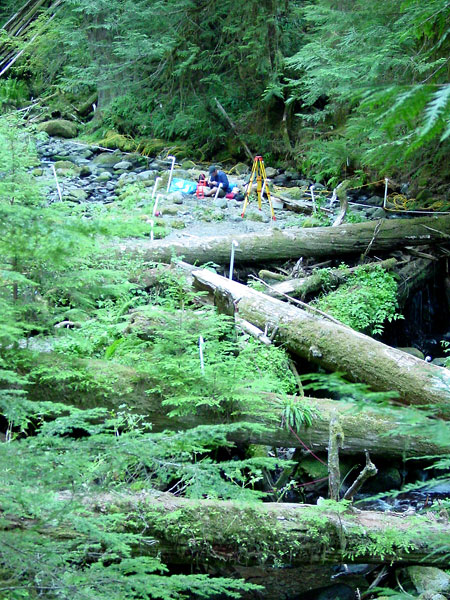 |
View looking upstream across the Mack Creek field site, figure is sat on a sediment wedge which has formed behind the large woody debris in the stream channel. |
Background:
The interaction between subsurface fluxes of water, solutes, and biogeochemical processes is of critical importance to the stream ecosystems, especially those that are nutrient limited. The region where these subsurface-surface water interactions occur is the hyporheic zone. The hyporheic zone can serve as either a source or a sink for limiting resources (e.g., nitrogen) and is an important location for biogeochemical and temperature alteration in stream ecosystems. Our objective is to better understand the hyporheic zone processes associated with denitrification (i.e., the removal of biologically available nitrogen) in stream networks and to quantify the influence of the hyporheic zone on whole stream nitrogen cycling. Our approach couples hyporheic tracer and denitrification experiments with hydrodynamic modeling. The integration of geophysical surveying with our extant empirical approach and hydrodynamic model development provides an opportunity to realize unprecedented precision in modeling hyporheic denitrification.
Investigators report
Photographs:
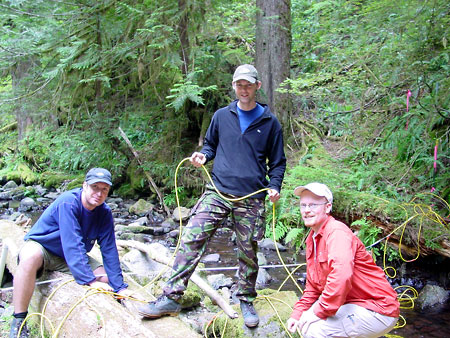 |
The field team at HJ Andrews, OR, from left Nigel Crook (HMF Geophysics – Stanford University), David Robinson (HMF Geophysics – Stanford University) and Jay Zarnetske (PhD student – Oregon State University). |
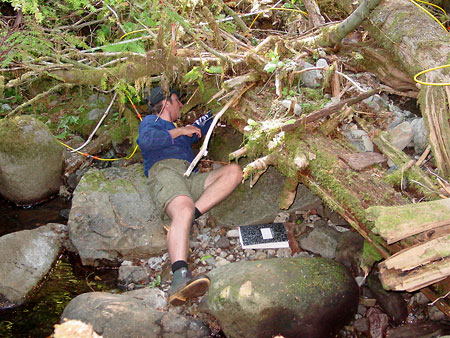 |
Getting the stainless steel electrodes into the ground for the resistivity lines was interesting at times in this challenging environment. |
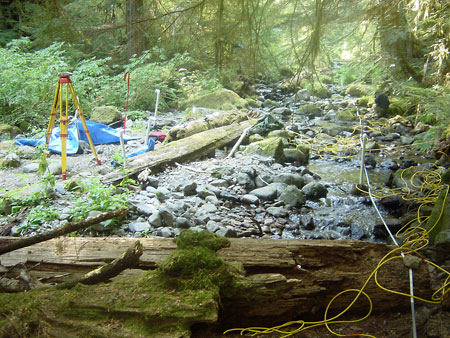 |
Looking upstream across the sediment wedge along a typical resistivity line. The white PVC tubes are piezometers from previous tracer experiments looking at denitrification through the hyporheic zone. |
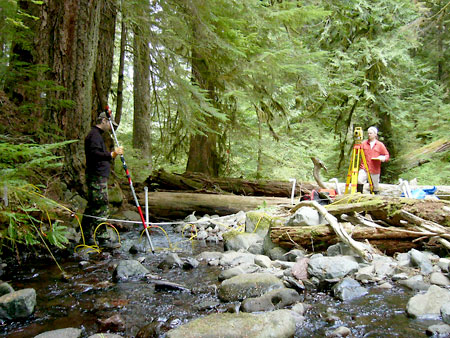 |
David and Jay surveying the position of each electrode using a total station. |
Research outcomes:
The following are links to conference proceedings or publications resulting from the collaboration between the investigators and HMF Geophysics:
Zarnetske et al. - AGU Fall 2006 meeting poster session H51D
Budget:
A generalized budget for this work is provided to give an idea of the costs associated with these surveys.