Current Activities | Recent Activities | Past Activities
Pilot Watershed Partnerships: USDA Reynolds Creek Experimental Watershed
Using Electromagnetic Induction to Determine Soil Properties in a Small Watershed
Location - USDA Reynolds Creek Experimental Watershed, ID
Watershed partners - Utah State University, USDA-ARS, HMF Geophysics
Date - July 2006
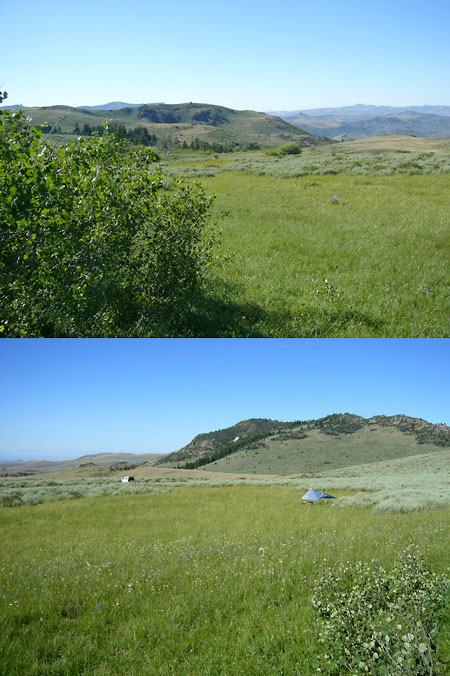 |
Views looking NW (top) and NE (bottom) from the top of the Reynolds Creek Experimental Watershed, ID. |
Background:
The concept of the work is to integrate the use of geophysical tools to assist in mapping soils. Traditional soil mapping uses photographic interpretation and pedon description and is limited in its use for understanding the role of soils in hydrology at the small watershed scale, due to low resolution. Our goal is to test the use of electromagnetic methods, including geophysical tools such as electromagnetic induction, to determine if it can be used to map soils and determine soil properties. Properties of interest are the clay%, water content and soil hydraulic properties.
In addition a small scale integrated study was conducted using the geophysical tools electrical resistivity and electromagnetic induction, in the upper part of the watershed. The goal was to investigate the links between the soil moisture distribution derived through the electromagnetic induction mapping and the subsurface architecture imaged through the use of the electrical resistivity.
Investigators report
Photographs:
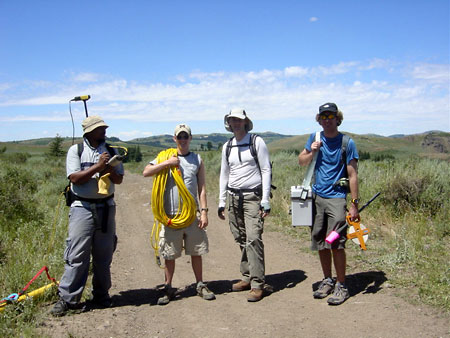 |
The field team at Reynolds Creek, ID, from left Hiruy Abdu (PhD student – Utah State University), Bryce Golden-Chen (Undergrad student – Stanford University), David Robinson (HMF Geophysics – Stanford University) and Nigel Crook (HMF Geophysics – Stanford University)
|
|
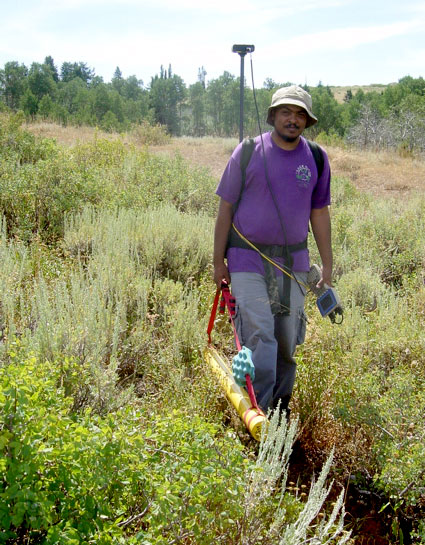
Electromagnetic induction mapping – the sensors are housed in the yellow tube with the resulting measurements being logged by the field computer along with the GPS readings for each point. |
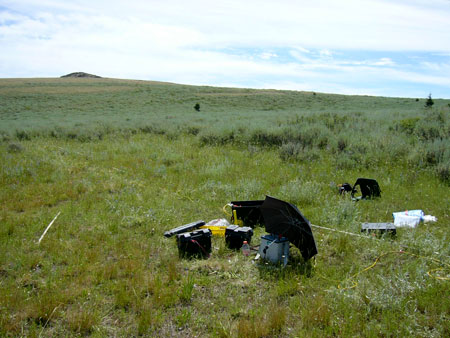 |
The electrical resistivity field set-up – the main control / logging unit is in the foreground, with external 12V battery power source, connected to the yellow cables which lead off to the left and right. These in turn connect to the electrodes embedded in the ground used in the resistivity measurements. |
Research outcomes:
The following are links to conference proceedings or publications resulting from the collaboration between the investigators and HMF Geophysics:
Crook et al - AGU Fall 2006 meeting poster session H51D
Abdu et al - AGU Fall 2006 meeting poster session H51D
Budget:
A generalized budget for this work is provided to give an idea of the costs associated with these surveys.